
Woven labels are woven on clothes and pants, and contain words, letters, and logo patterns. It is difficult to deliver a finished woven label to customers and satisfy them. Because a complete woven label, in addition to development, flower writing, and proofing, has to go through many manual processes. However, according to users, some woven labels shrink after washing. What is the reason? How to solve it? Let me introduce it to you below.
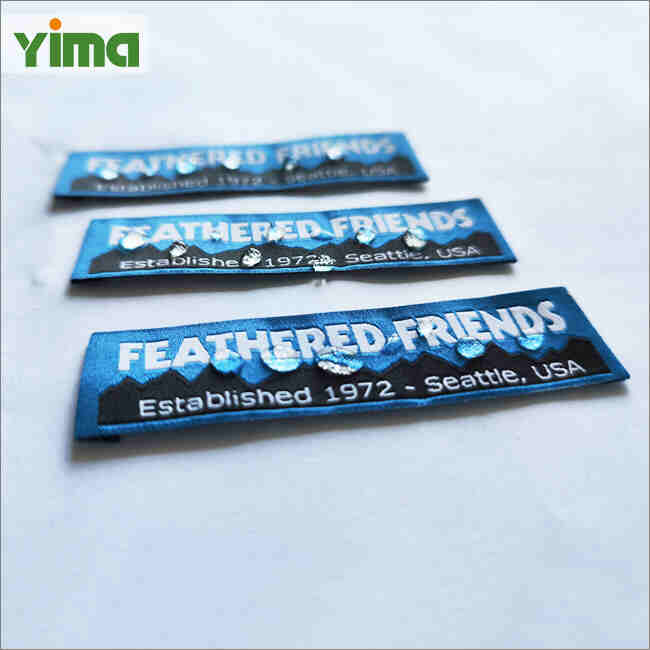
Reasons for shrinkage:
1. Because the fabric and webbing are made of different materials, the organizational structure is also different, so the shrinkage rates of the two materials are different, and the shrinkage is very different;
2. Because of the special workmanship, for example: the webbing is used in the collar, sleeve or car flower and other parts, and the bending range is relatively large;
Solution:
It is recommended that when the clothes need to be washed, the webbing should be used to test its shrinkage rate first, so as to determine whether the shrinkage of the webbing and the shrinkage of the fabric will cause different situations, or use the webbing to test the ready-made clothes to ensure that each process can go smoothly. At the same time, it is also necessary to carry out the deformation and wrinkling found in the washing test, especially when the waves are formed, it is necessary to replace other styles of webbing and replace the webbing material of this style, all of which are to avoid the risk of deteriorating the quality of clothing. Of course, such a test method cannot be used in our daily life, so it is necessary to conduct accurate testing during production to ensure that the produced webbing has no quality problems.
FAQ
Shrinkage occurs primarily because of the differential contraction between the label’s fibers and the garment’s fabric. Most woven labels are made of polyester or damask threads, which react to heat and moisture differently than cotton or wool. If the label is not “pre-shrunk” or heat-set during production, the high temperatures of a washing machine or dryer cause the synthetic fibers to tighten. This leads to the “puckering” effect, where the label pulls on the surrounding garment fabric, distorting the look of the brand area.
The most reliable solution is to implement high-temperature heat-setting (ironing or steaming) during the final stages of label manufacturing. By exposing the labels to temperatures higher than those they will encounter in a household wash, the fibers are “locked” into their final shape. Additionally, choosing high-quality, stable polyester yarns and using an ultrasonic cutting method can help maintain the label’s dimensions. For luxury brands, designers often opt for a “loose” sewing technique or a “center-fold” instead of a “flat-end” fold to allow for slight natural movement of the fibers without affecting the garment’s appearance.